Email still carries the daily work of most organizations. Contracts, password resets, invoices, HR notices, vendor updates. That makes it useful, and it also makes it a target.
Attackers know this. They do not need to break every firewall when one convincing message can get a user to click, reply, approve a payment, or hand over credentials. Now AI is making those messages cleaner, faster, and harder to spot.
For security teams, the issue is not just AI-written spam. It is phishing that reads as if it came from a real colleague, vendor impersonation without the usual grammar mistakes, and social engineering that can scale without much manual work. Older controls still catch plenty, but they are starting to miss the attacks that look routine.
What Is Generative AI in the Context of Email Security?
Generative AI refers to systems that can create new content, including text, images, code, and audio, based on patterns in existing data. A broader explainer is available here: What is generative AI?
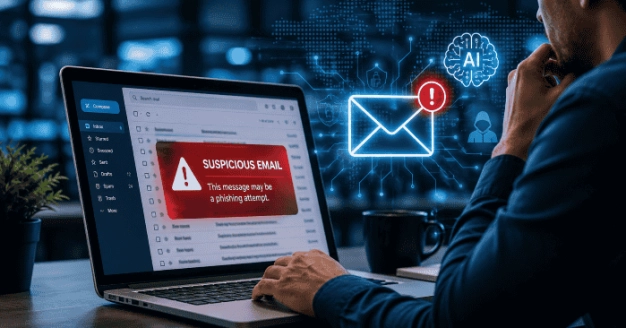
In email security, the concern is narrower. Attackers use the same content-generation capability to write phishing emails, fake vendor messages, login lures, and executive impersonation attempts that sound more natural than older templates.
That is where the risk changes. Many users learned to look for broken grammar, strange phrasing, or clumsy formatting. AI reduces those tells. Not every message is perfect, but more of them are good enough to survive a busy inbox.
How Attackers Use AI in Email Campaigns
AI gives threat actors a faster way to build believable email attacks. Phishing templates can be rewritten for finance, IT, legal, or executive teams. A fake invoice request can sound routine. A password reset lure can match the tone of a real service notification.
Business email compromise gets sharper, too. An attacker can study public posts, company pages, leaked emails, or previous conversations, then generate a message that mimics a vendor or manager. Not perfect every time. Good enough often enough.
Social engineering also benefits from volume. Instead of sending one generic message to thousands of people, attackers can generate small variations for each target group. Different subject lines, different urgency, different wording. Same payload.
Key Risks for Organizations
The first risk is realism. AI-generated emails can look less suspicious than traditional phishing, especially when they avoid obvious mistakes. Users may not see the usual red flags because there are fewer of them.
The second risk is filter evasion. Legacy email security tools often depend on known indicators, bad domains, attachment patterns, or reputation signals. AI-written messages may not carry those signals at first. Clean text, new infrastructure, no obvious malware. Still dangerous.
Speed is another problem. Attackers can generate and test campaigns quickly, then shift when detection improves. Security teams end up chasing versions of the same attack rather than one fixed template.
Personalization makes the damage worse. A message built around a user’s role, location, manager, or recent company activity has a better chance of landing. That is where recycled public data turns into operational risk.
Common AI-Driven Email Threats
Threat Type | What It Looks Like | Business Impact |
AI phishing | Fake alerts, invoice notes, or internal requests that read clean enough to pass a first glance | Stolen logins, mailbox access, follow-on attacks |
Business email compromise | A vendor, executive, or finance contact asking for payment changes or sensitive files | Wire fraud, exposed data, messy cleanup |
Email spoofing | Sender names or lookalike domains that feel familiar until someone checks the details | Brand abuse, confused users, and more false trust |
Malware delivery | Shared document links, staged downloads, or attachments wrapped in normal business language | Endpoint compromise, lateral movement, downtime |
Help desk abuse | Password reset or MFA requests that sound as if they came from a real employee | Account takeover, bypassed controls, access creep |
Protection Strategies Against AI-Powered Email Threats
Layered defense still matters. More now, not less. No single filter catches every AI-generated message, and no training program turns every user into an analyst.
Advanced email security tools should inspect behavior, sender history, domain patterns, message intent, and anomalies in communication flow. Basic keyword matching is too thin for this problem. A clean message can still be hostile.
Authentication controls need to be in place. SPF, DKIM, and DMARC help reduce spoofing and unauthorized domain use. They will not stop every impersonation attempt, but they remove easy paths and make abuse more visible.
User training has to be practical. Teach employees to verify payment changes, unusual file requests, password reset messages, and urgent executive instructions through a second channel.
Monitoring matters after delivery, too. Watch for mailbox rules, strange logins, impossible travel, OAuth abuse, and unusual forwarding behavior. A phishing email is often just the first move.
AI as a Defensive Tool
AI is not only helping attackers. Security platforms also use it to detect abnormal communication patterns, score message intent, group similar campaigns, and speed up triage. That can reduce analyst drag when inbox volume spikes.
Still, defensive AI needs clean data and tuning. Poor signals create false positives. Blind trust creates misses. The useful setup is human review supported by automation, not automation pretending the problem is solved.
Incident response can also improve. AI-assisted systems can summarize suspicious threads, identify related messages, and help teams remove threats from mailboxes faster. Useful during containment. Not a replacement for judgment.
Best Practices for Security Teams
Email audits should happen regularly, especially around authentication, forwarding rules, privileged mailboxes, and third-party access. These are boring checks until they stop a breach.
Strong authentication is required. MFA, conditional access, and tighter controls for admin and finance accounts reduce the blast radius when credentials get stolen. Passkeys are worth planning for where supported.
Security teams should connect email telemetry with endpoint, identity, and network data. A suspicious message is one signal. A suspicious message followed by a new login, mailbox rule, and file download is a case.
Policies also need maintenance. Attackers adjust. Controls age. Review exceptions, stale allowlists, abandoned accounts, and vendors with weak mail setups before they become the easy route in.
Final Thoughts on Generative AI and Email Security
Generative AI is changing email security in a practical way. Attacks are faster to build, easier to personalize, and harder for users to judge at a glance. The old warning signs still show up sometimes, but they are not reliable enough to carry the defense.
For security teams, the response has to be layered. Strong authentication, tuned email filtering, domain protection, user verification steps, and post-delivery monitoring all need to work together. Some malicious emails will still get through. The goal is to catch the activity before it turns into stolen credentials, payment fraud, or wider access across the environment.
FAQs
What is Generative AI in email security?
It is AI being used to write or shape email content. In attacks, that usually means phishing emails, fake vendor notes, executive impersonation, or login lures that sound closer to normal business email.
How does Generative AI improve phishing attacks?
It cleans up the obvious tells. Bad grammar, strange tone, clumsy wording. Those are used to make users pause, but AI can strip out a lot of that friction and make the message feel routine.
How can businesses protect against AI-driven email threats?
Keep the controls layered and boring. Use stronger email filtering, enforce SPF, DKIM, and DMARC, require MFA, train users on real approval workflows, and watch identity activity after suspicious emails land.
Is AI used for email security defense?
Yes, but it still needs supervision. AI can flag unusual sender behavior, group related phishing attempts, and help analysts triage faster. It depends on clean data, tuned rules, and people who know when something feels off.


 PREVIOUS
 NEXT
NEXT 
Other FAQs
- Exploring Malicious Code Risks: Strategies for Email Safety
- Proven Strategies for Effective Malware Removal on Windows Computers
- Why Outsourcing Email Security is Critical for Modern Businesses
- Comprehensive Guide to Safeguarding Against Domain Spoofing Threats
- Effective Strategies to Combat Insider Threats in the Workplace
- Strategies for Email Authentication to Counter CEO Impersonation
- Critical Factors for Selecting Email Security Solutions in Business
- Harnessing Managed Security Services for Enhanced Cybersecurity Vigilance
- Effective Penetration Testing Techniques for Cybersecurity Enhancement
- Managed SIEM Solutions: Boosting Email Security for Small Businesses

Join Our Community
of Readers!