Every email has to survive a long chain of handoffs before it reaches an inbox. It may pass through SMTP servers, DNS checks, spam filters, secure email gateways, outbound relays, and receiving systems. Each step depends on protocols that decide whether the message is encrypted, authenticated, delivered, rejected, or quietly exposed.
Most users could not name those protocols. They should not have to. But for anyone running infrastructure, building apps, or managing email security, the protocol layer is where the whole thing either holds up or starts to crack.
Email makes the problem easy to see. A message does not go straight from the sender to the inbox. It moves through SMTP servers, DNS lookups, spam filters, Secure Email Gateways, outbound relays, and receiving systems. Every hop has to protect the data, preserve trust, and avoid breaking the message on the way through. One weak handoff is enough.
How Secure Protocols Actually Work
TLS does most of the work once the data is moving. SSL is the old story now, but it still gets mentioned because people use the names loosely. TLS 1.3, finalized by the IETF in 2018, cleaned up a lot of the handshake by removing extra back-and-forth and dropping cipher suites that had no real place in modern infrastructure.
The handshake is not magic. The client and server agree on how they’ll encrypt the session, check certificates, create session keys, and then let the actual data move. In most current setups, AEAD ciphers like AES-GCM or ChaCha20-Poly1305 handle encryption and integrity together, which cuts down on the old split between “hide the data” and “prove nobody changed it.”
Email uses that same idea, but it drags older design choices behind it. SMTP was built to get messages delivered, not to hold up under phishing, downgrade attempts, and modern inspection layers. STARTTLS helps by upgrading a plaintext mail connection into an encrypted one, but only when both sides support it and policy forces the issue. Otherwise, it is just an offer, not a guarantee.
That is where downgrade attacks become a problem. If a connection can be pushed back to plaintext, or if a mail server accepts weak delivery without complaint, the protocol did not really protect the message. It only offered protection. Different thing.
MTA-STS and TLS Reporting help close that gap. MTA-STS tells sending mail servers to require TLS for a domain. TLS Reporting gives mail teams visibility into failed secure delivery, bad certificates, and possible downgrade attempts. Boring logs. Useful ones.
Proxies, Gateways, and the Application Layer
Routing matters just as much as encryption. A connection can have a protected payload and still leak useful metadata through timing, headers, source IPs, or the systems it touches along the way.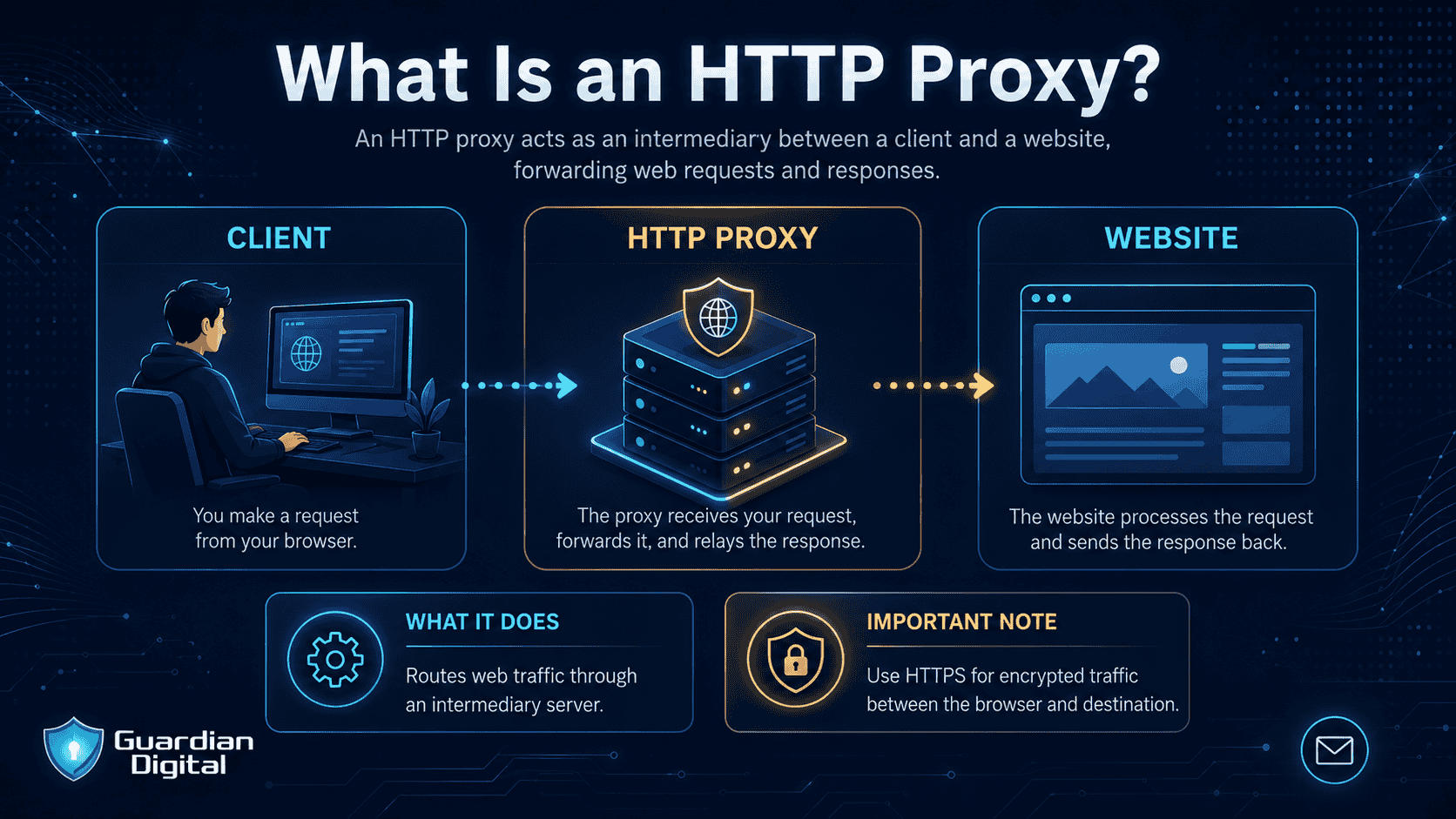
In web traffic, an HTTPS proxy can create an encrypted tunnel between the client and proxy server, which limits what intermediaries can inspect before traffic reaches the destination. Plain HTTP proxying does not give you that same protection. It can expose request headers, URLs, authentication tokens, and session details to anyone watching the wire.
Email has its own version of this problem. Messages often pass through Secure Email Gateways, spam filters, cloud mail security tools, journaling systems, and outbound relays before they land in a mailbox. Those layers can help catch phishing, malware, and spoofing. They can also rewrite headers, break authentication, or create blind spots during triage.
SOCKS5 sits lower in the stack. It can forward different kinds of TCP traffic, which makes it useful for SMTP, database connections, and other application traffic. But SOCKS5 does not encrypt by default. If TLS or another secure layer is not sitting above it, the protection is not there.
Heartbleed is still the reminder people bring up for a reason. The 2014 OpenSSL flaw exposed credentials, session data, and private keys across a large slice of the web before patching caught up. The protocol design can be solid, and the implementation can still put everyone in incident mode.
Email Authentication and Message Integrity
Encryption does not prove a sender is trustworthy. A phishing email can move over TLS and still be a phishing email. Secure transmission protects the channel. Email security also has to prove who is allowed to send and whether the message has been changed in transit.
SPF checks whether a sending server is allowed to send mail for a domain. DKIM adds a cryptographic signature to parts of the message, so the receiver can check whether those parts were altered. DMARC ties SPF and DKIM back to the visible From domain and tells the receiver what to do when authentication fails.
This is where Business Email Compromise gets practical. Attackers do not always need malware. They need a believable sender, a weak domain policy, and a user who sees a familiar name in the inbox. If DMARC is still sitting in monitoring mode, reports may come in while spoofed mail keeps landing.
DKIM carries a lot of the integrity work. The sender publishes a public key in DNS, signs the message, and the receiver validates the signature. If signed content changes on the way through, the check fails. Clean idea. Messier once forwarded systems, gateways, and mailing lists, and started rewriting messages.
DMARC alignment helps close that gap. It checks whether the authenticated domain lines up with the From address the user actually sees. That matters because attackers love gaps between what the mail system validates and what the recipient trusts.
The Protocol Stack at a Glance
Layer | Protocols and Controls | Primary Security Role |
Transport | TLS 1.3, STARTTLS | Encrypts data in transit between systems |
Enforcement | MTA-STS, TLS Reporting | Reduces downgrade risk and exposes failed secure delivery |
Routing | HTTPS proxies, Secure Email Gateways, cloud relays | Controls traffic paths, inspection points, and metadata exposure |
Sender Trust | Verifies whether a sender is authorized and aligned with the domain policy | |
Integrity | DKIM, AEAD ciphers, MACs | Helps prove data or message content was not modified |
Visibility | DMARC reports, TLS reports, gateway logs | Supports triage, abuse tracking, and policy tuning |
Where Protocol Design Is Headed
Protocol design is moving toward security being built in earlier. Less bolt-on work after something breaks. QUIC is one example. It runs over UDP, pulls TLS 1.3 directly into the transport design, and reduces connection setup time compared with older patterns.
Email upgrades tend to move slowly because the system depends on thousands of independent providers, gateways, clients, DNS records, and legacy mail servers all behaving well enough together. Still, the direction is clear. MTA-STS makes encrypted delivery harder to skip. TLS Reporting gives teams better failure data. BIMI adds visible brand indicators on top of DMARC enforcement, though it should not be treated like transport security. It is a trust signal, not armor.
Post-quantum cryptography is the next pressure point. NIST has selected its first quantum-resistant algorithms, and major TLS libraries have been testing hybrid key exchange models that pair classical and post-quantum methods. Some of that is future planning. Some of it is already showing up in vendor roadmaps and architecture reviews.
Looking Ahead
Protocol choices used to feel like backend trivia. Now they affect user privacy, email deliverability, fraud exposure, regulatory risk, and incident response. The inbox is just one place where the stack becomes visible.
Teams that track TLS posture, certificate health, DMARC enforcement, proxy behavior, gateway logs, and post-quantum readiness will have fewer surprises when the next shift hits. Not none. Fewer.
Secure data transmission is not one protocol doing one job. It is transport encryption, routing control, sender authentication, integrity checks, and reporting working as a chain. Email proves that every day. When one link fails, attackers usually find it before the dashboard looks clean.


 PREVIOUS
 NEXT
NEXT 
Other FAQs
- Exploring Malicious Code Risks: Strategies for Email Safety
- Proven Strategies for Effective Malware Removal on Windows Computers
- Why Outsourcing Email Security is Critical for Modern Businesses
- Comprehensive Guide to Safeguarding Against Domain Spoofing Threats
- Effective Strategies to Combat Insider Threats in the Workplace
- Strategies for Email Authentication to Counter CEO Impersonation
- Critical Factors for Selecting Email Security Solutions in Business
- Harnessing Managed Security Services for Enhanced Cybersecurity Vigilance
- Effective Penetration Testing Techniques for Cybersecurity Enhancement
- Managed SIEM Solutions: Boosting Email Security for Small Businesses

Join Our Community
of Readers!