Compared to LLMs or Gen AI, agentic AI tools can do much more. Instead of just analyzing messages, they triage emails, escalate tickets, reset passwords, and change mailbox settings independently.
However, traditional SIEM platforms weren’t designed to monitor machines operating autonomously. The logs will show the action, but can’t show the reasoning that pushed the agent there.
That gap matters once agentic tools start making security decisions at machine speed. Teams need visibility into what each agent sees, what they concluded, and what they touched next. Safe deployment means watching the agent the same way we watch users and endpoints. However, with human oversight, AI agents open up new possibilities for SIEM monitoring and control.
How Agentic AI Tools Upgrade Your Email Stack 
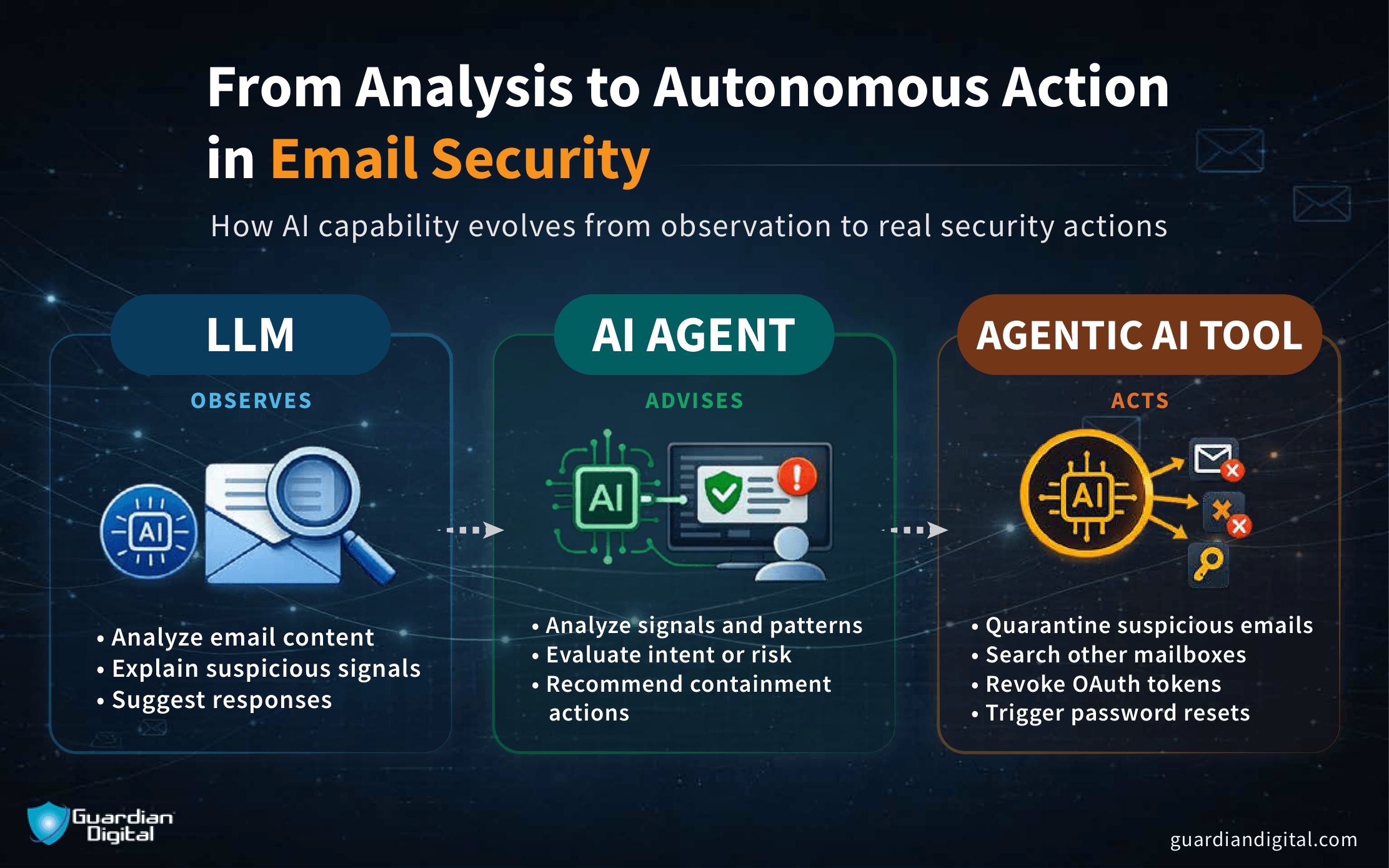
Agentic AI tools change how email security works by rapidly detecting behavior, evaluating intent, and responding in real time. This is what it means for SIEM performance:
Advanced Threat Detection and BEC Protection
Traditional email security runs on indicators. Known sender domains, malware hashes, and attachment signatures. That worked when phishing kits reused the same infrastructure for months, but attackers don’t operate that way anymore, and static rules will miss new variants.
AI SIEM platforms can flag display name impersonation attempts, unusual executive writing patterns, and vendor payment requests that don’t match historical behavior. The system can alert users to suspicious messages during an attempted BEC attack.
Payload analysis also improves. Links, attachments, and embedded scripts are inspected in context. Suspicious pages can be opened in controlled environments that simulate user interaction. Credential harvesting pages, spoofed domains, and hidden redirect chains become easier to identify before a user clicks.
Automated Response and Containment
Response speed is one of the most significant upgrades. Agentic SIEM platforms can quarantine suspicious messages in real time, search other mailboxes for similar emails, and pull them before employees interact with the content. Identity controls can also kick in automatically. OAuth tokens get revoked. Compromised accounts get disabled. Password reset workflows start immediately. SOC teams notice the difference quickly.
As organizations experiment with autonomous security automation, security leaders are also examining broader use cases of agentic AI across operations. These include automated incident investigation, adaptive threat response, and continuous monitoring workflows that allow security platforms to respond to emerging threats without waiting for manual intervention.
SOC Efficiency and Alert Reduction
Manual triage drops. Alert noise shrinks as benign anomalies get suppressed. Containment happens faster because automation removes the delay between detection and action. Faster response time is often the difference between a single compromised account and a broader incident that moves laterally through the organization.
Agentic AI changes the operating tempo of the email security stack. Systems can observe behavior and act without hesitating. While this can improve the effectiveness of the whole email security operation, teams also need to consider if their infrastructure is prepared to handle the decisions of autonomous agents.
Agentic AI Challenges for SIEM Platforms
Most SIEM models weren’t built for the shift to agentic AI tools. Not just detecting threats, but supervising autonomous systems that are quickly making decisions inside the environment. Their speed helps during incidents, but it also means mistakes pile up even faster. A small logic error or bad signal can propagate across dozens of mailboxes before anyone notices. Any team that is considering agentic AI tools needs to anticipate and plan for these challenges.
Monitoring and Alerts
Traditional monitoring assumed a human actor moving step by step. Autonomous agents break that pattern. SOC teams have noticed that ransomware detection built for human-driven activity often floods dashboards with alerts when an AI agent acts across several accounts simultaneously. Correlation rules treat the activity like a burst anomaly. Dashboards fill up. Analysts end up triaging a storm of alerts that came from their own automation.
AI Agent Accountability
Logging becomes its own problem. Every automated action leaves a record, and the volume climbs quickly once agents start executing workflows across accounts. A SIEM might capture the event, but rarely the reasoning behind it. Analysts see that a mailbox was quarantined or a rule changed. The system rarely explains why the agent decided to do it. Investigations slow down because intent is missing.
Determining the Scope of Autonomous Actions
Permission scope also becomes riskier once automation enters the loop. Agentic tools usually rely on broad API access so they can operate across mailboxes, filters, and retention policies. If that scope is misconfigured, the same automation meant to stop phishing could introduce lateral movement paths or trigger permission errors across connected systems. Even basic phishing simulations become more complex, now that some attackers deliver payloads using real-time phishing kits, and legacy SIEM rules aren’t equipped to separate those automated attacks from legitimate AI actions.
You can’t treat agentic email security automation the same way you treat normal SIEM and SOAR playbooks. Agentic AI tools demand you rethink scoping, logging, and oversight before you even consider letting them act autonomously.
Supervising Agentic AI in SIEM Platforms
Once you bring agentic AI tools into the environment, traditional monitoring isn’t enough. You need a way to not just see what happened, but to supervise what the agent is doing as it happens. A true agentic SIEM treats AI workflows like any other entity in your system, with permissions, behavior patterns, and containment requirements.
You get continuous validation of agent behavior against policy baselines. The system can throttle or suspend an agent that crosses defined thresholds before it causes broader issues. Context-aware escalation triggers notifications only when an agent’s action is truly risky, rather than flooding analysts with every automatic change.
Pre-deployment permission modeling becomes critical. If an AI agent has broad mailbox or API access, the SIEM highlights those risks upfront. It can also trigger an automated rollback when an action violates a defined boundary, like removing mailbox permissions or forwarding sensitive messages externally.
Risk scoring changes as well. It’s no longer just user privilege. Agent autonomy level, scope of actions, and historical workflow behavior feed into your visibility. That means you can supervise patterns instead of reacting to anomalies. A misfire from an agent no longer turns into hours of chasing events in logs.
When your SIEM models intent and history over time, you move from chasing “what happened” to supervising “what is allowed to happen.” Analysts gain control without slowing down automation, and SOC teams can respond before small mistakes become major incidents.
Monitoring shifts from a reactive task to ongoing behavioral governance. You no longer wait for alerts to pile up; you see when the agent starts acting outside its defined boundaries and can intervene immediately. Upgrading email security tools can help teams centralize alerts from multiple platforms and gain better visibility into automated workflows.
Policy and Governance Adjustments For Agentic AI Tools
When AI agents start making changes in your email environment, you can’t rely on old policies. Agents need their own access rules separate from human users. Approval chains must be clear before granting permissions, and someone has to have the authority to roll back actions if a mailbox gets locked or retention rules are altered.
Every action has to be logged and documented. Analysts need to be able to track what the agent did and why. Periodic reviews of agent behavior help catch mistakes. Even small misconfigurations can trigger data breaches if an agent accidentally exposes sensitive information.
SOC teams also need to define ownership. Who is responsible when an AI agent blocks a user or forwards sensitive emails? Without clear accountability, troubleshooting and compliance audits become a nightmare.
Decision Framework for Deploying Agentic SIEM in Email Security
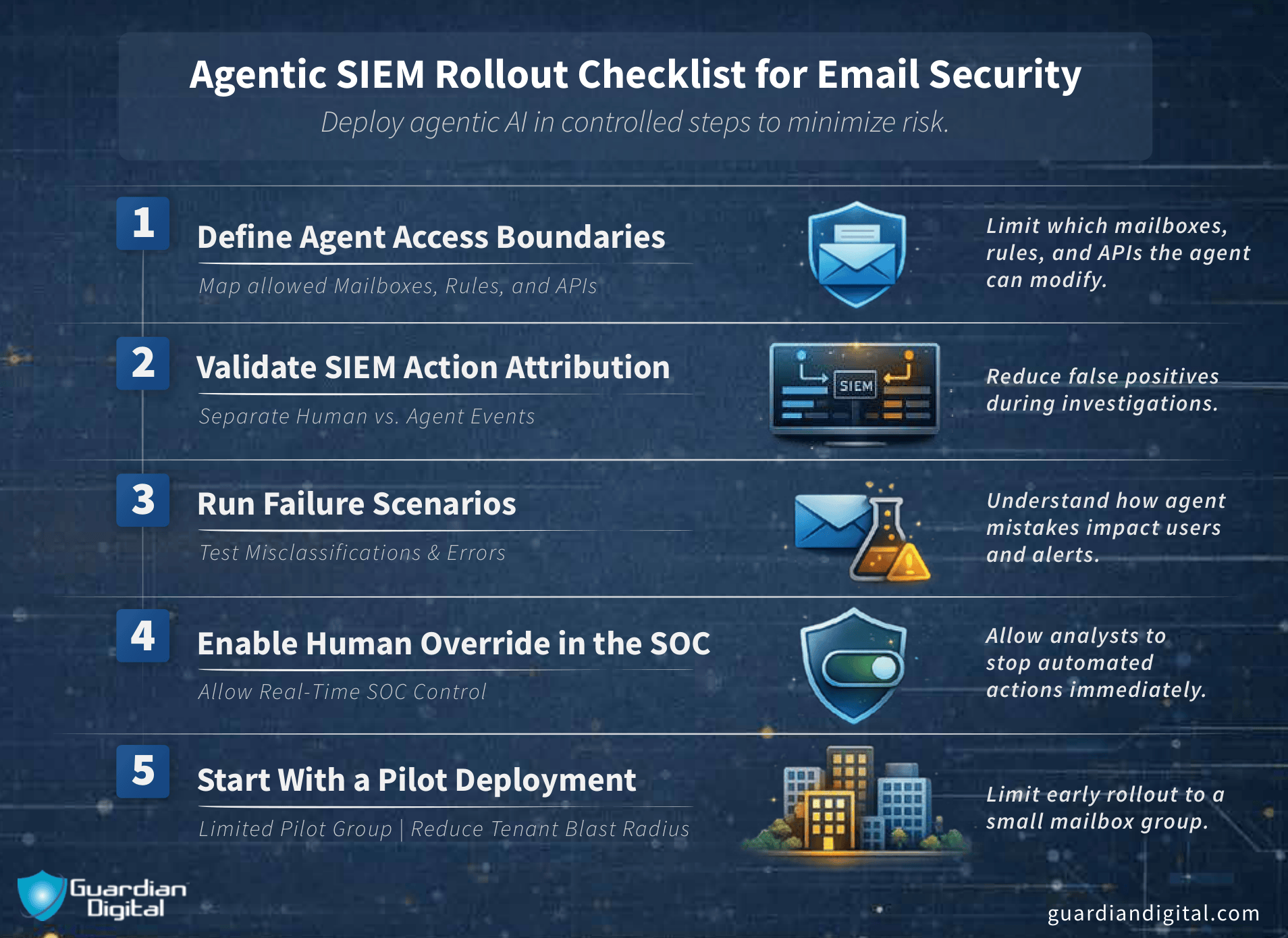
Bringing AI agents into your email stack isn’t just flipping a switch. You need to know exactly what each agent can touch. Map out which mailboxes, rules, or APIs it’s allowed to handle before giving access. If you skip that, mistakes spread fast.
- Check whether your SIEM can tell the difference between human actions and agent actions. Without that, alerts pile up, and your team could spend hours chasing false positives. Run scenarios where the agent mislabels messages or quarantines accounts by accident. Watch what happens and adjust permissions.
- Make sure your SOC can step in and override the agent in real time. Phased rollouts are better than full autonomy from day one. A small pilot reduces blast radius and makes mistakes manageable.
- Watch for AI phishing scams that can trick even automated systems.
The point isn’t to slow down AI. It’s to keep it predictable, auditable, and under control before it starts touching everything in your email environment.
Agentic SIEM Platforms: Controllability Over Capability
As agentic AI tools gain wider adoption, the question is how we keep them accountable.
If your monitoring can’t distinguish agent-driven action from human activity, rollback authority is undefined, and the SOC can’t intervene in real time, autonomy increases risk instead of reducing it. Deploying AI without these guardrails is like giving someone the keys to the server room and walking away.
With that in mind, you can set up boundaries to keep AI agents governable under pressure. With a properly managed SIEM, deploying agentic AI tools will improve efficiency and extend the capabilities of small IT teams.
FAQ: Agentic AI tools & SIEM Platforms
These are the questions everyone should consider before bringing agentic AI into the security loop.
How do agentic AI tools affect email compliance requirements?
When AI agents act on mailboxes, every action can trigger an email compliance check. Access changes, auto-forwarding, and retention modifications need to be logged and auditable. Teams have to treat AI actions like they would any privileged user.
Can traditional SIEM platforms monitor autonomous AI actions?
Not really. Standard SIEMs are built around human patterns. Alerts flood in when an agent takes multiple automated steps, and it’s hard to distinguish false positives from real issues without tagging agent activity separately.
What logs should be mandatory for AI-driven email workflows?
At a minimum, track who or what initiated the action, when it happened, which mailbox or system was affected, and why the agent performed it. Context is key for cybersecurity audits and troubleshooting.
How do you prevent AI agents from overreaching API permissions?
Define strict scopes and enforce pre-deployment permission reviews. Periodically audit what agents actually use versus what they were granted.
What’s the audit trail requirement for automated mailbox changes?
Every action that affects access, retention, or delivery must be visible in a centralized log. The trail should clearly show intent, not just the resulting change.
How do you differentiate malicious automation from approved AI behavior?
Baseline expected agent workflows. Any deviation triggers alerts for human review. Behavioral context is critical.
Should AI agents have separate service accounts?
Yes. Treat them like privileged users. Separate accounts make it easier to scope permissions, monitor activity, and revoke access if needed.
How does agentic SIEM reduce false positives in email environments?
By understanding agent behavior patterns and supervising actions in real time, it filters out alerts that are normal AI operations while still highlighting genuine risks.
What are the risks of letting AI auto-remediate phishing?
Misclassification can lock users out, forward sensitive information, or break critical workflows. Without supervision, small errors scale fast.
How do you phase in agentic controls without disrupting operations?
Start with low-risk workflows, monitor actions closely, and expand gradually. Keep human oversight until confidence in the agent’s behavior grows.


 PREVIOUS
 NEXT
NEXT 
In this article
Stay Informed with Our Latest Insights
- Why Email Thread Hijacking Makes Compromise Harder to Detect
- Calendar Phishing Attacks: How Malicious Invites Bypass Email Defenses and Change Enterprise Risk
- SaaS Attacks and Email Security: How SaaS Platforms Became the Delivery Layer
- Data Leaks from AI-Generated Code Are Fueling Email Breaches
- How to Protect Your Business Against Spear Phishing: A Defense Playbook

Join Our Community
of Readers!
Must Read Blog Posts
- Phishing Scams in 2026: The Rise of AI and Deepfake Risks
- Understanding Email Viruses: Detection, Prevention, and Security Strategies
- Effective Phishing Protection: Strategies and Training for Businesses
- Essential Ransomware Strategies for Effective Business Protection
- Maximizing Email Security: Advanced Strategies for Threat Defense
- Microsoft 365 Phishing: Why Attacks Still Reach Inboxes and How to Stop Them