Many software developers are using AI tools to assist with writing code. While these tools can be helpful for speeding up the process, letting AI touch coding repositories carries an inherent risk.
That’s because AI-generated code is picking up secrets and spreading them. Secrets are hardcoded tokens, API keys, and even test credentials that were left behind during development. As teams lean harder on AI-generated output, the volume of exposed credentials grows, and those credentials don’t stay contained to the app they were meant for.
If an AI coding assistant publishes secrets tied to identity systems that control SSO and inbox access, this gives hackers an opportunity to scrape this information. From there, they have exactly what they need to compromise email platforms from the backend.
Why AI Coding Assistants Expose Data 
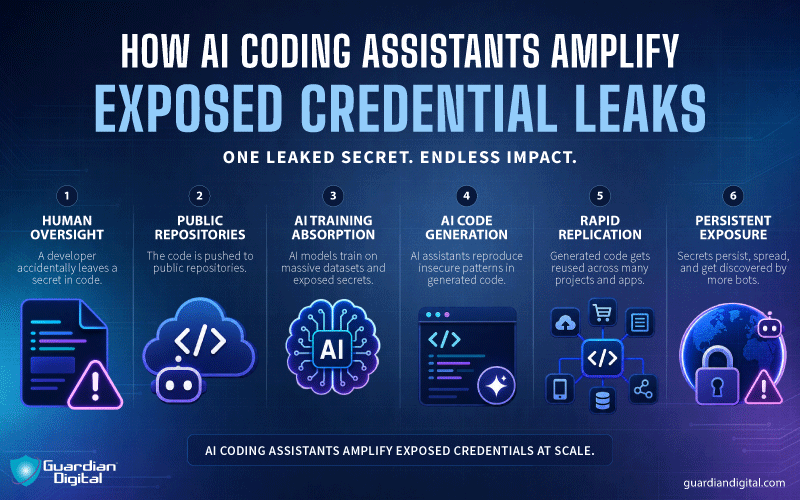
AI coding assistants inherit patterns from the data they were trained on, and a lot of that data came from public repositories where API keys, access tokens, and database credentials were already exposed. Then, this sensitive data will show up again and again in generated snippets that get accepted without much scrutiny during development.
AI-generated code accelerates an existing problem. Humans also leave secrets behind when they write code, but now the risk isn’t isolated to development mistakes. Once an AI assistant absorbs this information, it rapidly replicates the secret credentials in new code. The speed of AI coding assistants makes it much more laborious to catch slip-ups with human oversight.
Then, if the AI-generated code is shared in public repositories, it multiplies the problem by allowing more bots to scan it. After that, the secrets don’t stay local. They get reproduced by other AI assistants across different projects. Cleanup rarely keeps pace. Credentials get reused, and even when one instance is removed, duplicates tend to persist elsewhere.
How AI-Driven Data Leaks Undermine Email Security
When developers copy AI-generated outputs into the working code branches of email platforms without removing reused secrets, it enables email data leaks at scale.
Attackers mine public repositories for exposed secrets using automated, high-speed tools. AI is already part of that loop, speeding up discovery. From there, they can test the credentials from leaked secrets against the cloud email security infrastructure until they find an opening.
Once attackers can bypass identity authentication, they gain a steady foothold in user email accounts. Operating within a trusted account allows them to read email threads, reset passwords, and launch phishing attacks and AI email threats from a legitimate address.
Reused credentials let attackers move across cloud services, internal tools, and email systems without needing new exploits. At that point, they’re just replaying what already works in slightly different places.
Reusable credentials are an expanding problem. Researchers have found that 65% of the companies on the Forbes AI 50 have already leaked passwords and digital keys on GitHub. Reused credentials from the leak give attackers backend access to these companies. Then, hackers could use exposed AI models to infiltrate the numerous email clients and connected apps that integrate chatbots or AI assistants.
Once exposed, these paths don’t close cleanly. Credentials get copied, cached, and tested over time, which turns a single leak into a long-lived access point that can be revisited whenever defenses drift or monitoring misses a signal.
How To Prevent AI-Generated Data Leaks
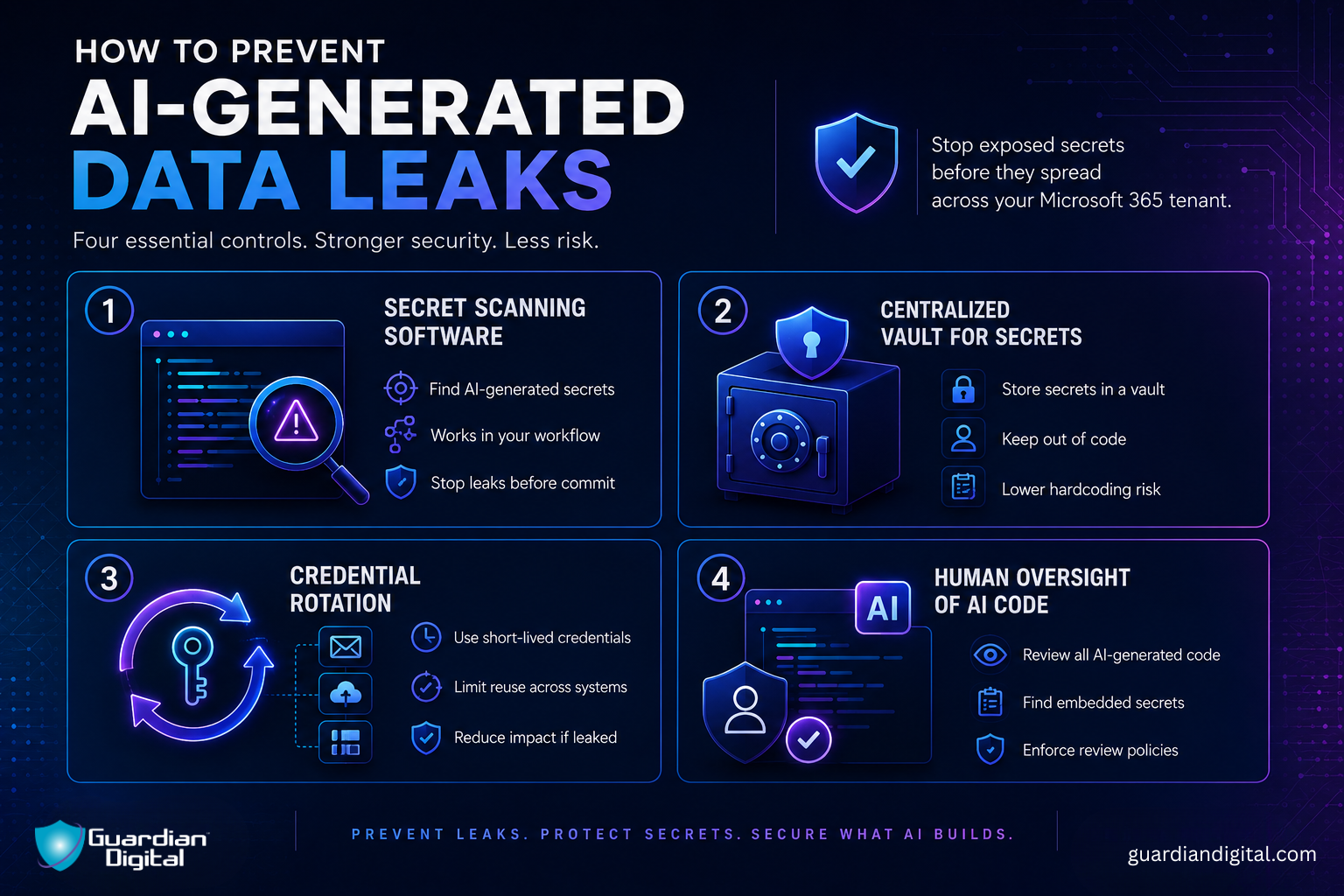
In order to prevent AI-generated data leaks, developers need a reliable method of checking for secrets that they incorporate into their coding workflow from the beginning. One approach to this is secret scanning, a security feature that can process code to detect sensitive information that was left exposed.
Dedicated secret scanning tools like BetterLeaks are starting to focus on patterns tied specifically to AI-generated output, not just obvious hardcoded keys. Adjusting the scanning method to find AI data leaks is critical because these leaks don’t always look like traditional ones and can blend into otherwise valid code until something breaks or gets abused.
Centralizing secrets also helps, but only if teams actually use it. Vault-based approaches keep credentials out of code entirely, though in practice you still see fallback habits where developers hardcode values during testing and forget to remove them, and those are the ones that tend to persist longer than expected.
Rotation policies close some of the gap. Short-lived credentials reduce the window of abuse, but they don’t fix reuse across systems, especially when the same identity ties into email, cloud services, and internal tools, where one exposed token can still open multiple paths.
Monitoring needs to extend into email behavior. Tracking API usage, login patterns, and abnormal sending activity helps surface abuse earlier, and platforms built to prevent email account compromise tend to catch the downstream impact even when the original leak goes unnoticed.
The part that still gets skipped is developer-level validation. AI-generated code should be treated as untrusted input and reviewed for embedded secrets before it is finalized. Strict review policies are important because once secret credentials make it into a code repository, even briefly, their proliferation is already outside of the developer’s control.
The Future of Automated Coding and Email Security
Sure, AI is speeding up development, but it’s also pushing more questionable code through at the early stages. A lot of it will look fine on the surface, so it gets approved, merged, and forgotten. By the time something hits production, the damage is usually done. Credentials have already been exposed, scraped, and tested somewhere outside your environment.
Email keeps getting pulled into this because it’s tied to everything. Access, recovery, notifications, internal trust. Once someone gets a valid credential that touches identity, email is usually one of the first places they test, and if it works, they’ve got a foothold that doesn’t look suspicious right away.
Security teams are adjusting, but success has been uneven. Some are tying code validation, identity controls, and inbox monitoring together; others are still treating them as separate problems, which is where things tend to slip through, especially in automated environments. However, AI email security tools focused on detection are starting to close that gap, especially around inbox behavior and auth patterns.
Protecting email isn’t downstream work anymore. It’s part of the same chain as code generation and credential handling, and if it’s not treated that way, you’re always reacting a step too late.
AI Code & Data Leaks FAQ
Below are some quick answers to help you understand the chain of events from AI-coding leaks to email account compromise.
Why does AI-generated code expose secrets?
Because it’s pulling from patterns that already existed in training data. If credentials were exposed in public repos before, those same patterns can show up again in generated output, just cleaned up enough that they don’t immediately look wrong.
Are data leak risks limited to public repositories?
No, because internal codebases can pick up the same risk when developers paste AI-generated snippets into private repos. Once it’s there, exposure can still happen through logs, backups, or misconfigurations that weren’t part of the original threat model.
What types of credentials get leaked by AI code assistants?
Mostly the ones that give direct service access. API keys, SMTP credentials, cloud tokens, sometimes tied to email systems or identity providers, which is where things escalate quickly once someone starts testing what still works.
Steps To Secure Your AI Coding Assistant
AI-generated code is adding another path for credentials to leak, and then inbox access is the next step.
The fix isn’t one control. It’s necessary to layer in scanning during development with backend monitoring, and some level of enforcement before code ever makes it into a production branch. Otherwise, you’re just catching leftovers.
Start with pipeline audits. Look for hardcoded secrets that developers left behind during the early stages of development, such as build artifacts and test configurations. Most accidental credential exposure can be found here, rather than in more polished code near the end of production.
Then, tighten visibility where it actually matters. Email API usage, authentication flows, and token activity. If something gets exposed, those are the systems attackers will touch first, and they usually leave signals if you’re watching closely enough.
Finally, align the workflow itself. AI-assisted development needs guardrails, validation of generated output, policy checks before merge, otherwise you’re scaling the same mistakes faster, just with better tooling.


 PREVIOUS
 NEXT
NEXT 
In this article
Stay Informed with Our Latest Insights
- Why Email Thread Hijacking Makes Compromise Harder to Detect
- Calendar Phishing Attacks: How Malicious Invites Bypass Email Defenses and Change Enterprise Risk
- SaaS Attacks and Email Security: How SaaS Platforms Became the Delivery Layer
- Data Leaks from AI-Generated Code Are Fueling Email Breaches
- How to Protect Your Business Against Spear Phishing: A Defense Playbook

Join Our Community
of Readers!
Must Read Blog Posts
- Phishing Scams in 2026: The Rise of AI and Deepfake Risks
- Understanding Email Viruses: Detection, Prevention, and Security Strategies
- Effective Phishing Protection: Strategies and Training for Businesses
- Essential Ransomware Strategies for Effective Business Protection
- Maximizing Email Security: Advanced Strategies for Threat Defense
- Microsoft 365 Phishing: Why Attacks Still Reach Inboxes and How to Stop Them