Short answer, yes.
The longer version is messier. AI on its own isn’t hostile. It’s just tooling. What’s changed is how cheaply and quickly it slots into existing tactics that work.
Attack chains haven’t evolved. They just got a lot more economical. Phishing, BEC, credential theft. Same mechanics, but now with better copy and faster production. Language errors vanish. Targeting tightens. Campaigns that used to take days now come together in minutes.
Defenders are using AI too. Everyone is. But attacker volume is still winning. Generation is faster than AI threat detection, and scaling AI-driven email scams is easier than tuning a model without breaking mail flow or drowning teams in false positives.
So the threat isn’t some new AI superweapon. It’s the old stuff, automated, polished, and sent at scale before most filters adapt. That gap is where inboxes keep getting burned.
This article breaks down what actually changed, what didn’t, and where email security strategies need to adjust.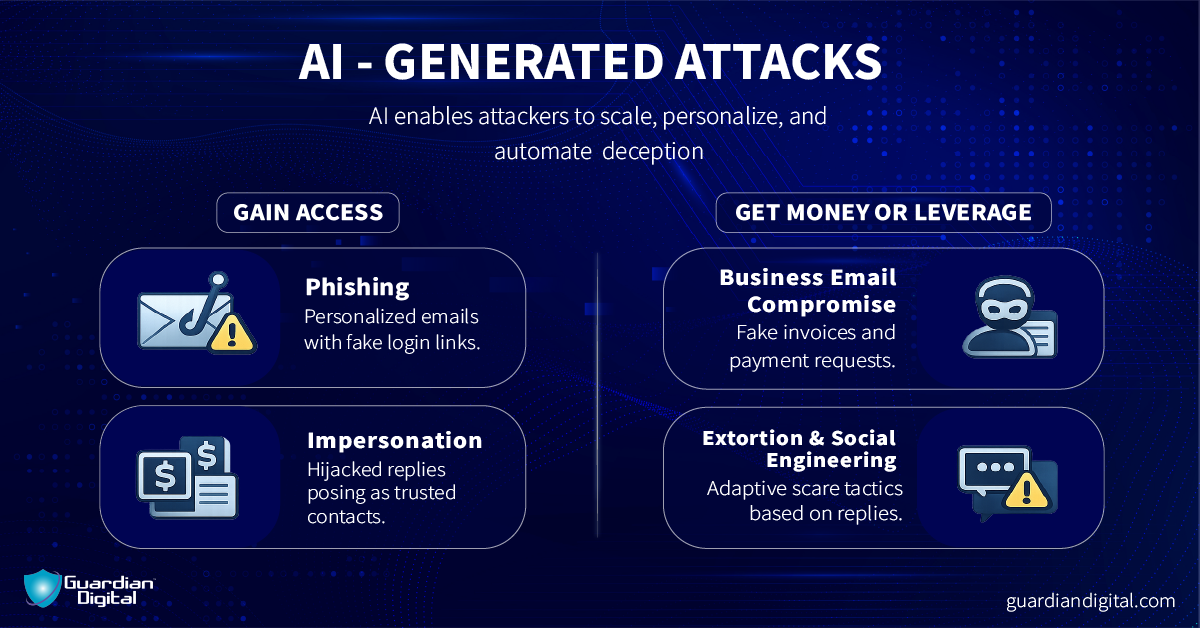
How Has AI Powered an Increase in Email Security Threats?
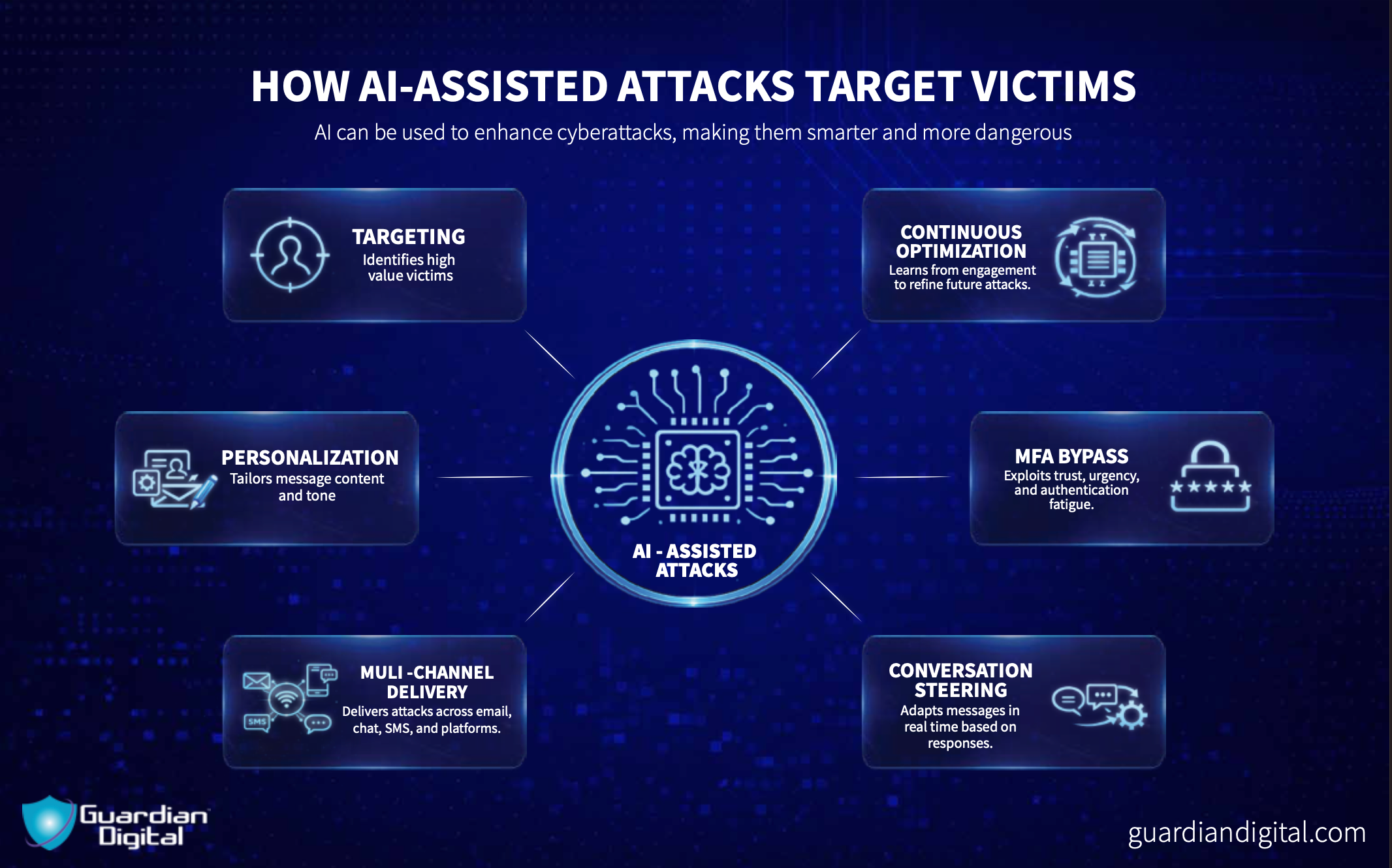
What AI offers hackers is greater speed and reliability for less work. Phishing and spear phishing are still doing the damage, but AI phishing campaigns have fewer obvious red flags than older templates ever did. AI-driven tooling lets attackers generate realistic phishing content on demand, tweak wording based on who they’re targeting, and spin up variations without having to rewrite every line. That matters because email security defenses still rely heavily on patterns, and AI email security has had to evolve quickly to keep up with messages that rarely repeat themselves.
Targeting has improved too. Public breach data, scraped social profiles, and leaked corporate documents feed models that understand roles, vendors, and internal language. The result is email that references real projects, real tools, and real people.
Reconnaissance and iteration are now automated. Attackers can test subject lines, timing, and phrasing at scale, then adjust based on who clicks or replies. That feedback loop used to be manual. Now it runs continuously in the background, which is why detection teams are seeing fewer obvious tells and more gray-area messages.
Reporting out of the World Economic Forum shows AI-related risk climbing faster than most other categories. Generative data leaks and adversarial use keep coming up. None of this is shocking once you look at how quickly AI spread into everyday workflows.
What is different is awareness. IT teams see the exposure now, both outside the org and inside it. Shadow tools, prompt leakage, models trained on the wrong data. All familiar problems, just wearing new labels.
Controls are being revisited because they have to be. Especially in email, where language stopped being a dependable signal a while ago. Detection can’t rely on tone or phrasing anymore, so teams are figuring out where AI threat detection actually fits into email security.
What Types of Threats Are Being Created with AI?
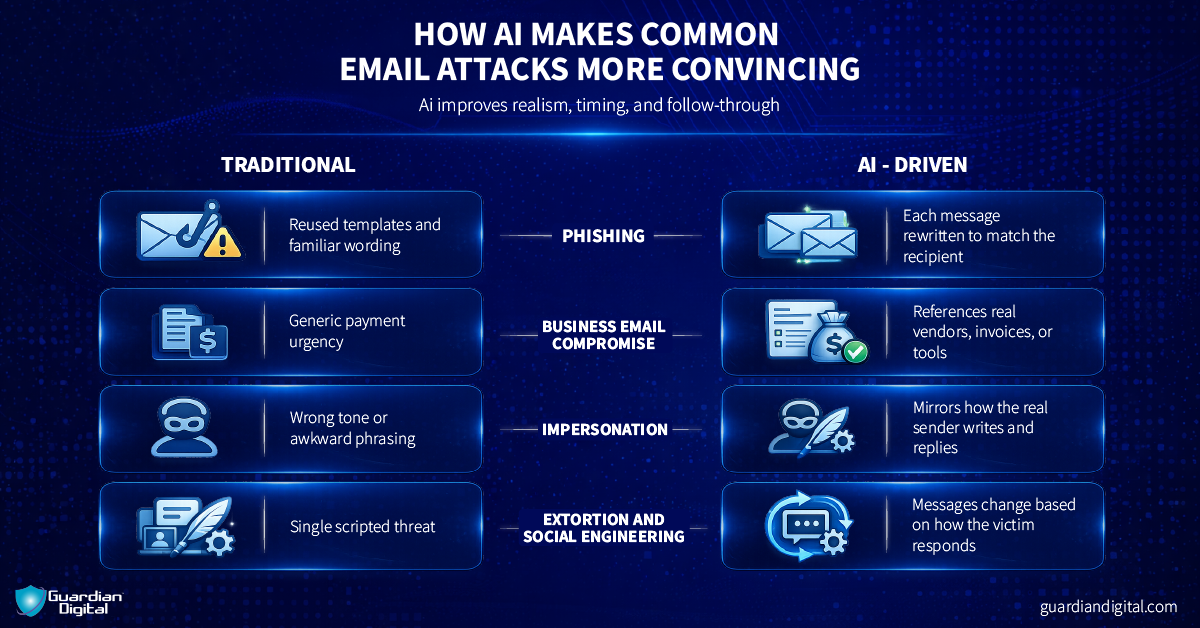
Most of what we’re seeing isn’t new attack classes. It’s old techniques running better. Phishing attacks and business email compromise are the clearest examples, with messages tuned to a role, a vendor relationship, or a moment in the workday when people are more likely to respond without slowing down.
Impersonation has tightened up as well. Attackers use scraped data to match tone, timing, and internal context, then send messages that look like they came from finance, IT, or an executive who actually exists. That context used to be sloppy or generic. Now it’s specific enough to pass a quick gut check, which is why business email compromise continues to drain organizations even when basic controls are in place.
Extortion and social engineering campaigns are also getting automated. AI handles the follow-up. If a recipient replies, the message adapts. If they hesitate, the pressure changes. From a detection standpoint, that back-and-forth matters because static rules can’t make sense of the whole conversation.
AI Platform and Agent Exploitation Risks
Generative AI is a powerful tool to enhance email-borne attacks, but this is only half of the risk that AI presents. The other side of the problem is the email platforms themselves. As organizations roll out internal chatbots and assistants that have access to company email data, they don’t always think through the operational guardrails needed to prevent the AI from leaking sensitive information. With adversarial prompting, unsecured AI configurations are a liability that can turn into full-scale data breaches before anyone notices.
Agentic systems add another layer of risk. When AI is allowed to take actions, not just answer questions, attackers can abuse it to automate workflows they used to run manually. Phishing prep, data collection, and even internal lookups can be chained together if access controls are weak, especially when those workflows rely on a trusted AI assistant app that users rarely question.
Unauthorized employee AI use, a.k.a “Shadow AI” only makes this worse. When teams spin up unsecured tools with internal data, it completely circumvents email security controls. If no one tracks what they connect to, then any third-party could access proprietary information without even setting off alarms. Combined with AI-driven attack tooling, that expanding surface area reflects the downside of the broader digital revolution, where speed often outpaces governance.
How Organizations Are Countering AI-Driven Email Threats
Defenders aren’t trying to out-generate attackers. That’s a losing game. What’s changing instead is how teams decide what looks wrong. Static rules and keyword hits are giving way to behavioral signals that flag when an email doesn’t line up with how a sender normally communicates or how a recipient usually responds. That’s where an AI-powered email security solution starts to make practical sense.
Identity controls are doing more of the heavy lifting. Stronger authentication, tighter access policies, and better validation of internal senders reduce the blast radius when impersonation slips through. Stopping a fake internal message early matters more than perfectly classifying every external one.
Organizations are also getting stricter about their own AI use. Policies around what data can be fed into tools, how prompts are logged, and who can deploy assistants are starting to look a lot like data loss controls from a decade ago, especially as executives weigh the usefulness of ChatGPT for CIOs when deciding how much autonomy these systems should have.
AI threat detection is being applied where humans and static logic fall short, especially across conversation flow and message evolution. Behavioral monitoring might not label every message correctly in isolation, but it will spot patterns that don’t make sense over time.
Practical Steps to Block AI-Driven Email Threats
Most of the defenses that work against AI-driven attacks are the ones teams already know about. DMARC, SPF, and DKIM still matter because they cut down impersonation at the source. When those controls are loose or inconsistently applied, attackers don’t need AI to win.
Data exposure is the next problem. The more public org charts, vendor details, and internal documents exist online, the easier it is to build convincing lures. Reducing what can be scraped, both externally and within the environment, limits the effectiveness of personalized attacks and directly improves email security across modern cloud email security deployments.
Training has to catch up as well. Generic phishing examples don’t prepare users for messages that reference real tools, real projects, and real people. Exercises need to reflect what detection systems are already seeing in the wild, or users will keep trusting messages that feel familiar.
Finally, internal AI systems need the same scrutiny as any other production service. Log access. Lock down permissions. Monitor usage patterns. If an attacker can pull context from a chatbot or assistant, they can feed it right back into the next wave of attacks.
AI Email Threat FAQ
Here’s a quick review of how AI-driven attacks are transforming email threats and security practices:
How is AI changing the way phishing and email scams are created?
Attackers no longer need to struggle with grammar, tone, or volume. They prompt once, generate hundreds of variant phishing scams, and tune language to the target’s role, region, or recent activity. Instant iteration replaced the need for time and skill.
Why does email remain the primary delivery channel for AI-driven attacks?
Email still touches everything. External partners, SaaS logins, password resets, invoices, HR workflows. AI didn’t make email attractive, it just made abusing it cheaper and easier at scale, especially when one inbox can open paths into cloud apps, VPNs, and internal tools.
What makes AI-driven social engineering harder to detect than traditional phishing?
AI social engineering attacks blend in better. They mirror internal language, reuse real threads, and avoid the awkward tells that defenders trained people to spot. Filters catch known patterns; AI shifts phrasing constantly, which turns detection into a moving target instead of a rules problem.
Are AI-generated phishing emails actually more successful than human-written ones?
Not always individually. At scale, yes. The advantage isn’t brilliance, it’s consistency and volume, plus the ability to quickly adapt when a campaign stalls or a template gets burned.
How do attackers use generative AI to impersonate real employees or executives?
They feed it context. Public posts, breached emails, job descriptions, org charts. The model fills gaps, matches tone, and produces messages that sound close enough to pass a quick read, especially when paired with spoofed display names or compromised accounts.
What role do enterprise AI tools and chatbots play in expanding email risk?
They widen the surface area. More automated messages, more system-generated emails, more trust in “machine-sent” notices. When users get conditioned to act on AI-written prompts, it becomes easier for attackers to slip malicious ones into the noise.
AI-Driven Threats in 2026 and Beyond 
AI-driven attacks don’t change the fundamentals. Social engineering still works because people trust what looks familiar, and AI makes that familiarity cheaper and faster to manufacture at scale.
Email isn’t going anywhere, which is why it stays the primary exploitation vector. In every incident review, it’s still the same story. A message looked normal. Timing lined up. Someone clicked. That reality keeps email security at the center of defensive strategy, whether teams like it or not.
AI-resilient organizations will need to be disciplined about user identity and AI tool permissions. To be effective, IT departments need visibility into how messages behave, policies that limit unnecessary exposure, and controls that are actually enforced. AI threat detection helps by spotting patterns humans miss, but it can only succeed when it’s backed by clean identity data and sane defaults.
The bigger risk is internal. Unmanaged AI adoption creates context that attackers can reuse, automate, and refine. In 2026, the teams that treat AI like any other high-risk system will have lower email vulnerability, fewer breach incidents, and will get the most out of their automated tools.
Sign up for Guardian Digital’s email security newsletter to stay up-to-date on emerging cyberattack trends, AI-driven email defenses, and more.


 PREVIOUS
 NEXT
NEXT 
In this article
Stay Informed with Our Latest Insights
- Why Email Thread Hijacking Makes Compromise Harder to Detect
- Calendar Phishing Attacks: How Malicious Invites Bypass Email Defenses and Change Enterprise Risk
- SaaS Attacks and Email Security: How SaaS Platforms Became the Delivery Layer
- Data Leaks from AI-Generated Code Are Fueling Email Breaches
- How to Protect Your Business Against Spear Phishing: A Defense Playbook

Join Our Community
of Readers!
Must Read Blog Posts
- Phishing Scams in 2026: The Rise of AI and Deepfake Risks
- Understanding Email Viruses: Detection, Prevention, and Security Strategies
- Effective Phishing Protection: Strategies and Training for Businesses
- Essential Ransomware Strategies for Effective Business Protection
- Maximizing Email Security: Advanced Strategies for Threat Defense
- Microsoft 365 Phishing: Why Attacks Still Reach Inboxes and How to Stop Them