Businesses with digital records need a strategy for managing information and protecting online privacy.
In this article, we take a closer look at why HRIS data protection matters, how advanced systems protect information, and best practices to ensure compliance and trust.
What Is HRIS 
HRIS, or Human Resource Information Systems, is a way to centrally manage all employee data. It enables companies to tie together payroll, SSNs, addresses, benefits, and sometimes even medical info in one place. An HRIS platform sounds neat on paper until you realize how much damage a single bad access path can cause.
Most teams think about HRIS in terms of features or automation. In reality, it’s a concentration problem, too much valuable data sitting behind controls that don’t always get reviewed as often as they should.
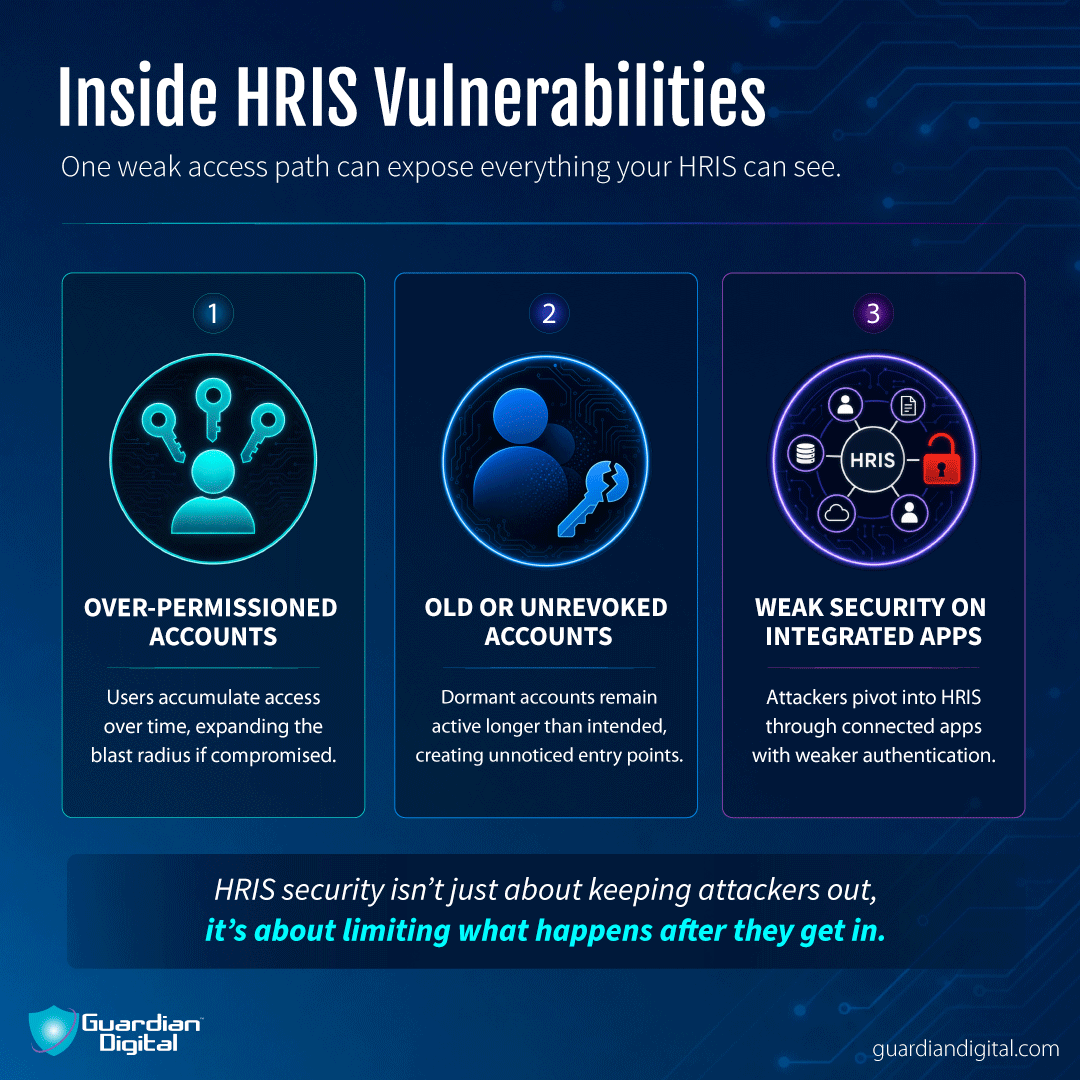
If there are over-permissioned accounts that never got cleaned up, or a user who still has access after switching roles, these are potential routes for threat actors to exploit. Once someone gets in through an unsecured path, they could potentially pull everything that the account can see. With that in mind, data breach prevention for HRIS isn’t entirely about keeping attackers out. It’s equally important to limit what can happen after they get in.
Internal data breach risks are always present. It’s not always malicious; sometimes it’s just a lack of awareness that leads to sloppy access control or someone exporting more data than they should. Without tight visibility, irresponsible user activity can blend in with normal operations.
Building a Secure HRIS Foundation
Most HRIS problems start during setup. Security decisions can get rushed or pushed aside because the system just needs to go live.
A solid foundation is really just a plan for how access, logging, and data flow are going to behave before you plug the HRIS platform into the rest of your environment.
Integration is where things get messy. HRIS connects into payroll providers, identity systems, email, sometimes even ticketing tools, and every one of those connections is another place where access can get wider than intended if no one is mapping it carefully.
Rolling security out all at once sounds clean. In practice, it drifts. You deploy controls, people change roles, new integrations get added, and six months later, the environment doesn’t look anything like what you originally secured, which is why regular review cycles matter more than the initial setup.
Before anything else, you need to know what’s already broken. That means looking at outdated controls, weak passwords, old service accounts, and gaps in things like endpoint security, because HRIS access often starts from a compromised user device, not the platform itself.
Multi-factor authentication should be everywhere, not just on admin accounts. MFA closes off a lot of easy entry points, especially the ones tied to reused credentials or basic phishing, which still show up more than anyone likes to admit.
Patching and monitoring don’t get much attention here, but they should. Systems that aren’t maintained start to drift in small ways, miss updates, have broken alerts, stale configs, and those small gaps are usually what get chained together when something actually goes wrong. Data breach prevention isn’t something you finish. It’s something you keep revisiting, because the environment keeps changing, whether you plan for it or not.
Third-Party Vulnerabilities
Don't let one bad integration undermine your HRIS platform. Make sure all integrated systems have the same level of security with strong, MFA-protected passwords.
How an HRIS Platform Supports Data Threat Protection
Most HRIS platforms come with decent security controls out of the box. The problem is how they’re used once they’re live, because controls that exist don’t always mean controls that are enforced the way you think.
Good setups bake security into the workflow itself. Not something bolted on later, but access, logging, and data handling built into how people actually use the system day to day.
The focus isn’t just blocking access. It’s limiting what happens after access is granted, which is where most exposure actually happens.
Role-Based Access Control (RBAC) in HRIS
RBAC sounds simple until you look at it a few months in. Roles get copied, permissions stack, and suddenly people have access that made sense once but doesn’t anymore.
Access should map tightly to job function. Payroll stays with payroll, HR data stays with HR, and anything beyond that should stand out immediately.
Over-permissioning is where things usually slip. Once an account is compromised, attackers don’t need to escalate if the access is already there, which is why cleaning up roles over time matters just as much as setting them correctly in the first place.
Encryption and Secure Data Storage in HRIS
Encryption is one of those controls that everyone assumes is handled. Most platforms do encrypt data in transit and at rest, but that’s only part of the story.
If data gets intercepted, data encryption makes it unreadable without the keys. That reduces impact, but it doesn’t stop exposure if access controls are weak.
Storage designed for data segmentation is also critical. Segmented data limits who can query it, as opposed to flat access models, which make encryption less meaningful once someone is inside.
Audit Logs and Monitoring for Data Breach Prevention
Logs are usually there. The issue is whether anyone is actually looking at them in a useful way.
Every access event should be tracked: user, timestamp, action, but raw logs don’t help much unless they’re tied into something that can flag unusual behavior tied to real-world patterns seen in data breaches.
Without visibility, things like bulk exports, odd access times, or unusual query patterns just blend into normal activity, and by the time someone checks, the data is already gone, leaving teams reconstructing what happened after the fact instead of catching it while it’s happening.
HRIS Best Practices for Data Threat Protection
Most of the real issues don’t come from missing features. They come from how the system is run day to day, especially once ownership gets split across teams and nobody’s fully watching the whole picture.
This is where small gaps add up. Vendor choices, user behavior, and how closely things are monitored tend to matter more than whatever default controls came with the platform.
HRIS Vendor Security and Data Protection Due Diligence
On paper, most vendors look solid. Same features, same claims, similar dashboards, but the differences usually show up when something goes wrong and you need clear answers fast.
Your HRIS platform inherits risk from whoever runs it. Weak vendor controls don’t stay contained; they extend straight into your environment, especially if that system is tied into identity providers or handles direct data exports.
Certifications like SOC 2 or ISO 27001 are a baseline. They tell you the vendor has been reviewed, not that their setup fits your risk tolerance or how they’ll respond under pressure.
Response matters more than paperwork. You need to know how they handle incidents, how quickly they can trace access, and where your data actually sits, because storage location and jurisdiction can complicate things fast when legal or compliance teams get involved.
Employee Training for Data Breach Prevention
Users are often the easiest way into a secure network, and a lot of exposure still starts with email. Attacks are designed to look routine, especially phishing attacks that blend into normal email traffic. Training helps, but only if it reflects what people actually see.
Generic modules don’t stick. What works better is showing how real messages slip through and how small mistakes, like reusing passwords or approving the wrong login prompt, turn into access.
Tightening email security reduces that entry point, but users still need to recognize when something feels off, because not every malicious message gets caught upstream. Fewer avoidable mistakes and faster recognition make a noticeable difference in those cases.
HRIS Platform FAQ
These are the questions that usually come up once teams realize the HRIS platform isn’t just an HR tool. It’s a high-value target sitting in the middle of identity, payroll, and internal access.
How do you start securing an HRIS platform?
You start by figuring out who has access and why. Not just admins, everyone.
Most environments already have drift by the time someone asks this question, so the first step is tightening access, enforcing MFA, and checking what’s exposed through integrations, because that’s where unexpected access tends to show up.
Why conduct regular vulnerability assessments for HRIS?
Because the environment doesn’t stay the same for long. New integrations, role changes, and system updates all introduce small gaps that don’t get noticed right away. Assessments help catch those gaps early.
Without them, weak points like outdated permissions or unpatched components sit there quietly until they’re chained together during an incident.
What is role-based access control in HRIS?
Role-based access control means people only see what their job requires. Nothing more.
In practice, it’s messy.
Roles get reused, permissions stack, and over time, users end up with access that no longer makes sense, which is why RBAC needs regular cleanup, or it stops being effective.
How does Zero Trust improve HRIS security?
Zero Trust shifts the model from “trusted once inside” to constant verification. Every access request gets checked based on context, not just credentials.
It reduces blind trust in internal access.
That matters for HRIS because a lot of risk comes from valid accounts doing the wrong thing, whether that’s compromised credentials or legitimate users accessing more than they should.
What common vulnerabilities affect HRIS systems?
Over-permissioned accounts show up a lot. So do stale credentials and service accounts that nobody tracks closely.
Misconfigured integrations are another one.
APIs connected to payroll or identity systems can expose more data than expected if scopes aren’t locked down, and those paths often get less attention than direct user access.
How can employee training protect HRIS?
Training reduces the easy entry points. Phishing, weak passwords, approving the wrong login request, those still drive a lot of initial access.
It’s not about perfect users.
It’s about fewer mistakes and faster recognition, which gives security teams a better chance of catching something early instead of dealing with it after data has already moved.
Strengthening HRIS Platforms for Long-Term Data Breach Prevention
Most teams don’t notice HRIS risk until something breaks. By then, it’s not about prevention anymore. It’s cleanup, reporting, and figuring out how far access actually went.
Systems hold up better when security is part of how they’re built, not something added later. That means access control, logging, and data handling are treated as core functions, not optional layers that get revisited once a year.
It shows during audits. Environments that have been maintained properly don’t scramble for logs or try to reconstruct access after the fact, because the visibility is already there, and the controls haven’t drifted far from how they were originally designed.
Long term, preventing HRIS breaches comes down to consistency. Strong data threat protection isn’t one decision; it’s a pattern of small ones, keeping access tight, reviewing changes, and not assuming the system still looks the way it did when it was first deployed.


 PREVIOUS
 NEXT
NEXT 
In this article
Stay Informed with Our Latest Insights
- Why Email Thread Hijacking Makes Compromise Harder to Detect
- Calendar Phishing Attacks: How Malicious Invites Bypass Email Defenses and Change Enterprise Risk
- SaaS Attacks and Email Security: How SaaS Platforms Became the Delivery Layer
- Data Leaks from AI-Generated Code Are Fueling Email Breaches
- How to Protect Your Business Against Spear Phishing: A Defense Playbook

Join Our Community
of Readers!
Must Read Blog Posts
- Phishing Scams in 2026: The Rise of AI and Deepfake Risks
- Understanding Email Viruses: Detection, Prevention, and Security Strategies
- Effective Phishing Protection: Strategies and Training for Businesses
- Essential Ransomware Strategies for Effective Business Protection
- Maximizing Email Security: Advanced Strategies for Threat Defense
- Microsoft 365 Phishing: Why Attacks Still Reach Inboxes and How to Stop Them