
It’s no secret that hackers are using artificial intelligence (AI). The advent of accessible AI platforms has given criminals a new tool to deploy in cyberattacks, noticeably increasing the volume and severity of online threats. Ransomware is no exception.
Ransomware attackers can use machine-learning algorithms to get their AI assistants to do the work of writing code and sending out email malware. A study from MIT Sloan in 2025 found that 80% of ransomware attacks are now powered by AI.This powerful technology is making a lot of online fraud possible, but AI could also help us find new ways to fight ransomware. We will look at email security solutions for AI ransomware protection and how to use these strategies to protect yourself right now.
What is Ransomware? 
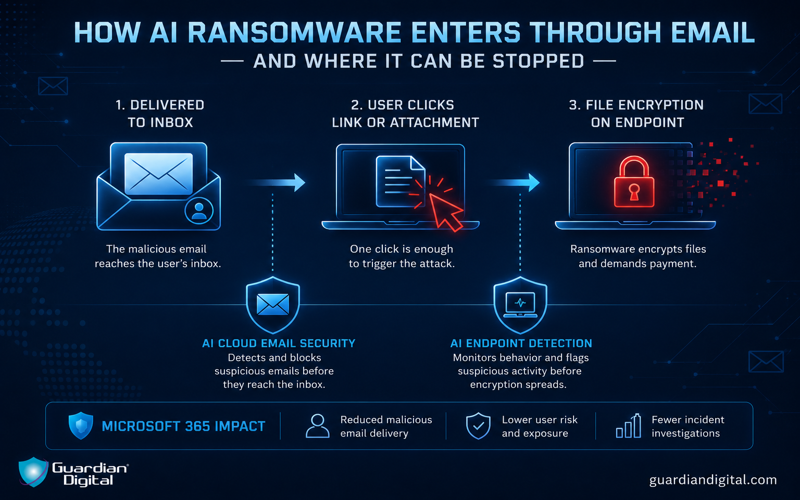
Ransomware is a type of malware that criminals use to steal and encrypt data so the owner can't access it. Then, they won’t unlock the data until the victims pay a fee. While it sounds simple, these schemes are a costly headache to recover from. Businesses have to pay for lost business, downtime, data recovery services, and may even lose clients, in addition to the ransom amount.
Email remains the easiest way in. One infected attachment or fake link is enough. To stop hackers from stealing private data through email malware, security measures must be able to keep up with AI-powered attacks.
How AI-Powered Email Security Solutions Defeat Ransomware
Machine learning algorithms excel at finding patterns. AI-powered security tools learn what normal looks like, then flag what doesn’t. With this ability, it can pinpoint ransomware activity much faster than human intelligence alone. That’s why AI-powered threat detection is a great solution for identifying anomalous traffic activity and locating ransomware threats before they encrypt your files.
Examples of AI Ransomware Protection
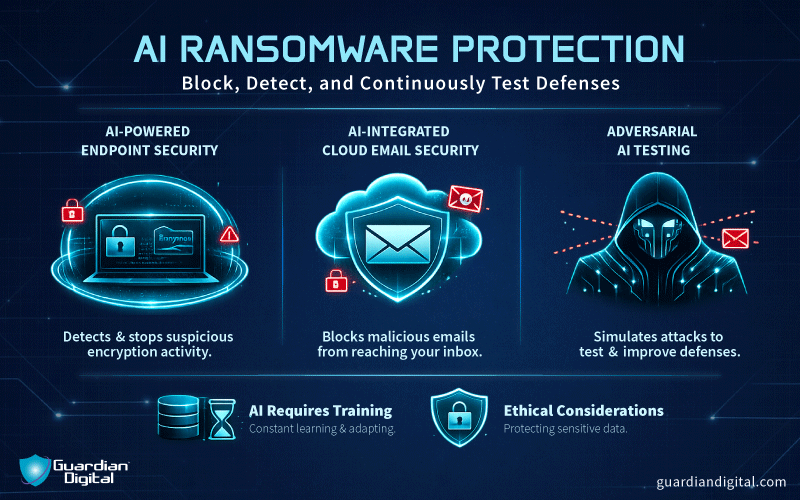
These are the adaptive, AI-powered email security tools that experts are currently employing to improve ransomware defenses:
AI-powered Endpoint Security Platforms
Endpoint security monitors device-level activities to stop ransomware in its tracks. It looks for file encryption activity or system changes that don’t fit the norm. AI-assisted endpoint protection can find suspicious changes to files, catching ransomware before it spreads. Modern AI-powered Endpoint Security Platforms can also combine behavioral analytics, automated threat detection, and continuous monitoring to identify suspicious activity across devices before ransomware can spread through an organization’s infrastructure.
AI-integrated Could Email Security
In addition to monitoring device activity, AI-powered cloud email security solutions can completely shut down the main vector of ransomware attacks. AI can recognize suspicious emails and prevent them from being delivered to the target’s inbox.
Adversarial AI Ransomware Protection
AI can also be a tool for training and research, rather than straightforward security. Adversarial AI studies use algorithms to simulate ransomware attack strategies. Just like cybersecurity “red teams,” AI-powered adversaries are a means to test the limitations of existing email security infrastructure and develop improved defenses.
Challenges in Implementing AI Ransomware Protection
As more organizations begin to use AI-powered ransomware protection, they should be aware of potential pain points:
AI Requires Training
Refining artificial intelligence models to achieve a specialist task is resource-intensive and time-consuming. Algorithms need a steady stream of new data and experiences. Companies that want to use AI ransomware protection need to be ready to pay these costs upfront, while accepting that the results won't show up right away. While defensive AI is brought up to speed, LLM-wielding criminals will continue to discover new ways to automate fraud.
Ethical Considerations
Ethical AI use matters too. Using AI in security means you’re feeding it real data, logs, emails, and user activity that shouldn’t leave a controlled environment in the first place. Things can go sideways fast if no one’s paying attention to how that data is handled or where it ends up. Companies should consult experts on differential privacy barriers to make sure that AI algorithms don’t violate compliance by using confidential information.
AI Ransomware Protection FAQ
Look at our answers below to review how AI-powered tools are used both for and against ransomware attacks.
How does AI make ransomware more dangerous?
Generative AI is being used to send out new ransomware programs more quickly and cheaply than before. When malicious software is unfamiliar to filters, detection becomes harder.
How do ransomware attacks happen?
Usually by email. Spam, phishing, or spear phishing delivers the payload. A single click can start encryption.
Can AI spot ransomware before it encrypts files?
Yes, by watching for abnormal behavior before the damage is done. Things like a user accessing way more files than usual or processes spinning up that don’t normally run.
Is ransomware a threat to small businesses?
Yes, because they’re easier to breach and more likely to pay. Limited IT resources make small businesses ideal targets.
What can AI ransomware protection do to improve email security and prevent ransomware attacks?
AI pattern recognition and adaptive learning make cloud email security solutions better at heading off suspicious emails. Effective email security limits hackers’ ability to remotely spread ransomware.
Should businesses use AI for ransomware negotiations?
No, it’s not something you can hand off to a tool. Too many variables. AI might be helpful for pulling context or analyzing past cases, but the actual legal and financial decisions demand human accountability.
Learn More About AI Ransomware Protection
There are obvious upsides and downsides to AI adoption. Criminals will probably keep using AI-powered ransomware attacks because they are so effective. In fact, illicit developers may soon make fully automated Ransomware as a Service (RaaS) kits the standard way to do business. On the other hand, cybersecurity experts are fighting back. With research and collaboration, they are upgrading email security systems to handle the next generation of cyberattacks. Ransomware will always be a threat, but businesses can leverage AI-powered technology to prevent hackers from holding their files hostage.
- Find out how Guardian Digital Engarde Cloud Email Security can help keep advanced threats like targeted spear phishing and ransomware at bay.
- Join our newsletter to get the latest information on how to stay safe online.


 PREVIOUS
 NEXT
NEXT 
In this article
Stay Informed with Our Latest Insights
- Why Email Thread Hijacking Makes Compromise Harder to Detect
- Calendar Phishing Attacks: How Malicious Invites Bypass Email Defenses and Change Enterprise Risk
- SaaS Attacks and Email Security: How SaaS Platforms Became the Delivery Layer
- Data Leaks from AI-Generated Code Are Fueling Email Breaches
- How to Protect Your Business Against Spear Phishing: A Defense Playbook

Join Our Community
of Readers!
Must Read Blog Posts
- Phishing Scams in 2026: The Rise of AI and Deepfake Risks
- Understanding Email Viruses: Detection, Prevention, and Security Strategies
- Effective Phishing Protection: Strategies and Training for Businesses
- Essential Ransomware Strategies for Effective Business Protection
- Maximizing Email Security: Advanced Strategies for Threat Defense
- Microsoft 365 Phishing: Why Attacks Still Reach Inboxes and How to Stop Them